
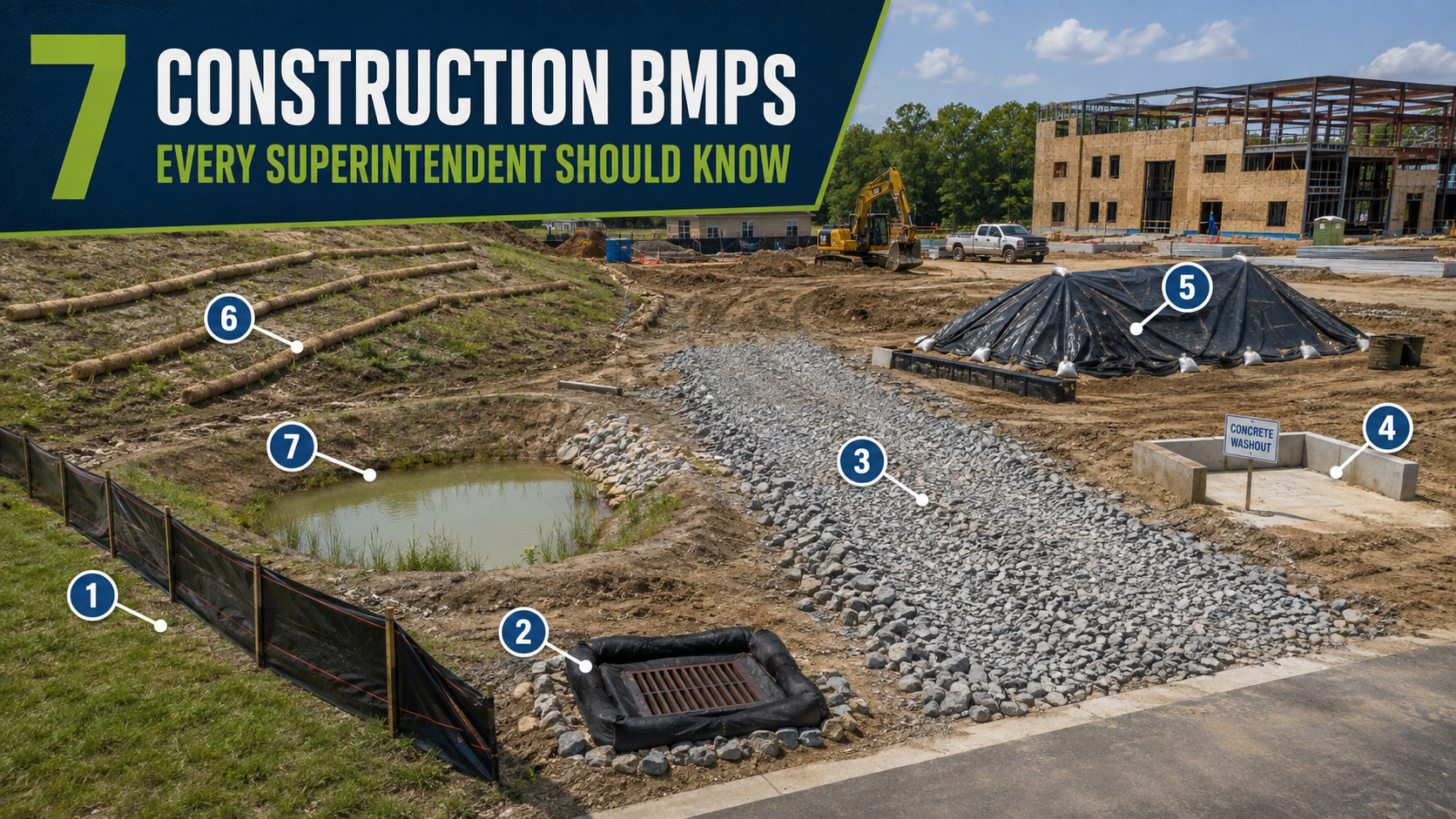
BMPs (Best Management Practices) in construction are on-site controls required by NPDES permits to prevent erosion, trap sediment, and prevent pollutants from leaving a construction site.
According to NPDES permitting guidelines, any site that disturbs one acre or more of land requires a procedural stormwater prevention plan (SWPPP).
The SWPPP for each site specifies which BMPs are required based on the site’s topography, soil type, disturbed acreage, proximity to receiving waters, and construction phasing.
A superintendent’s job is to ensure that those BMPs are installed as specified, maintained in good working order, and documented in weekly and post-storm inspection reports.
Unmaintained or improper BMPs can lead to stormwater runoff failures, resulting in EPA Clean Water Act penalties of up to $25,000 per day per violation.
In this guide, you’ll learn the core BMPs every superintendent will encounter on a site, proper installation and maintenance requirements, and how to conduct compliant weekly site inspections.
What Are BMPs in Construction?
BMPs in construction are measures that prevent or reduce the discharge of pollutants from a construction site into stormwater.
The term comes from EPA’s NPDES Construction General Permit (CGP), which requires operators of sites disturbing one or more acres to develop and implement a SWPPP (Stormwater Pollution Prevention Plan) that identifies all applicable BMPs for the site.
Under the EPA’s Construction General Permit (CGP), construction BMPs fall into three main functional categories:
- Erosion Controls: Soil-stabilization measures like hydraulic mulch, erosion control blankets, and temporary seeding that prevent soil detachment.
- Sediment Controls: Filtration and perimeter barriers like silt fences, sediment basins, inlet protection, and check dams that capture eroded soil before it escapes the site.
- Pollution & Waste Controls: Management practices like stabilized construction entrances and concrete washout areas that keep mud off roads and contain hazardous materials.
The Most Important Construction BMPs Every Superintendent Should Know
Each of the following BMPs is designed to prevent erosion while simultaneously controlling for sediment and helping your site maintain NPDES compliance.
Stabilized Construction Entrance
A stabilized construction entrance is a 50-foot stone pad built over geotextile fabric at site exits to clean mud off truck tires before they reach paved roads.
This BMP prevents sediment from tracking onto streets and entering storm drains.
Each pad is installed over coarse aggregate 6 inches deep and requires geotextile fabric beneath the aggregate to prevent mixing with the subgrade soil.
Each entrance must be maintained throughout the project. During heavy earthwork phases, a wheel wash station may be required in addition to the aggregate pad.
Silt Fence
Silt fence is a woven geotextile fabric stretched between wooden stakes along the downslope perimeter of a construction area.
It works by impounding sheet flow runoff long enough for sediment to settle out before the relatively clean water passes through the fabric.
A Silt fence is only designed for sheet flow; it is not a dam and will overtop or fail immediately if concentrated flow is directed at it.
Common silt fence failures that superintendents must prevent include:
- Stakes not driven deeply enough: Minimum 8 inches, ideally 12, with the bottom 6 inches of fabric trenched into the ground and backfilled
- Fabric attached to the upslope side of stakes instead of the downslope side: The fence must be able to bulge toward the flow
- End posts not returned uphill: Open ends allow runoff to flow around the fence rather than through it.
- Accumulated sediment not removed: Once sediment reaches one-third to one-half the fence height, the fence must be cleaned out to maintain freeboard
Sediment Basin or Trap
A sediment basin captures and holds runoff from a larger drainage area.
These BMPs are required when the contributing area exceeds 5 acres or when sheet flow concentrates into a channel or swale.
It works by holding runoff long enough for suspended sediment to settle before the water exits through a controlled outlet.
A sediment trap is a smaller, simpler version appropriate for contributing areas of 5 acres or less.
A construction superintendent’s maintenance responsibilities include checking that the outlet structure is unobstructed, that the basin has not filled to more than half its capacity (which requires sediment removal), and that the emergency spillway is clear.
Inlet Protection
Inlet protection devices, such as filter socks, rock-ring dams, or concrete block barriers, are placed around storm drain inlets to prevent sediment from entering the storm sewer system.
They are one of the most commonly required and most commonly neglected BMPs on construction sites.
The 2022 CGP requires inlet protection to remain in place and functional until the contributing drainage area is fully stabilized. Performing a post-storm inspection will identify displaced or clogged inlet protection.
Check Dams
Check dams are structures placed across a drainage swale or channel to reduce runoff velocity and allow sediment to drop out.
Rock check dams, silt-fence check dams, and wattle check dams are all acceptable options, depending on flow volume and channel characteristics.
Check dams must be spaced so that the toe of the upstream dam is at or above the downstream dam’s pool elevation; if the spacing is too wide, the channel between dams still reaches erosive velocities.
Temporary Seeding and Mulching
Temporary seeding provides vegetative cover on disturbed areas that will not be re-disturbed within 14 days. The 2022 CGP requires temporary stabilization within 14 calendar days of the last disturbance activity on any portion of the site.
Hydraulic mulch or erosion control blankets applied at the time of seeding provide immediate stabilization while the seed germinates.
On slopes steeper than 3:1, bonded fiber matrix (BFM) or erosion control blankets are required because standard hydraulic mulch does not maintain contact with the soil on steep grades.
Concrete Washout Area
Concrete washout water is highly alkaline and toxic to aquatic life. Allowing it to discharge to a storm drain, natural drainage channel, or the ground surface is a permit violation.
Every concrete pour on the site should be preceded by confirmation that the washout area is in place and accessible to the trucks. Washout areas must be emptied before they reach capacity and closed out properly at the end of the project.
Common Sources of BMP Failures on Construction Sites
BMP failures usually occur because the wrong control was selected for the site conditions, such as using a silt fence for heavy, concentrated water flow.
While the site’s Stormwater Pollution Prevention Plan (SWPPP) sets the initial controls, site conditions change as work progresses.
Under the 2022 Construction General Permit (CGP), inspectors and superintendents are responsible for identifying non-performing controls, updating the SWPPP, and immediately requiring corrective action.
The following table outlines common sources of BMP failure we have witnessed in the field.
| Site Condition / Problem | Wrong BMP (Common Error) | Correct BMP | Why It Fails / Correct Function |
| Concentrated Water Flow (Swales/Channels) | Silt Fence | Check Dams, Sediment Basins/Traps | Silt fences are designed only for light, sheet flow; concentrated flow causes immediate overtopping or blowout. |
| High Channel Flow Velocity | Undersized Check Dam | Properly Sized & Spaced Check Dams | Undersized dams overtop in the first heavy rain; proper spacing reduces water velocity down the channel. |
| Steep Slopes (>3:1) | Standard Hydraulic Mulch | Bonded Fiber Matrix (BFM) / Erosion Control Blankets | Standard mulch does not stick to steep grades, leading to severe slope erosion. |
| Vehicle Site Exits | Untreated Dirt / Bare Aggregate | Stabilized Entrance with Geotextile Fabric | Aggregate without fabric sinks into the soil, allowing tires to track mud onto public roads. |
The Importance of Regular BMP Maintenance
The 2022 CGP requires site inspections at least every 7 calendar days and within 24 hours of a storm event that produces 0.25 inches or more of precipitation.
Those inspections must specifically assess whether each BMP in the SWPPP is properly installed, maintained, and functioning.
For each BMP, the inspection record should document:
- Whether the BMP is in place and in the location specified by the SWPPP
- Whether it has sustained any damage, displacement, or deterioration since the last inspection
- Whether accumulated sediment requires removal to maintain freeboard or capacity
- Whether the BMP is adequate for the current site conditions — which may differ from conditions at the time of installation
- Any corrective action taken or required, with a completion date
Inspection records must be completed by the end of the next business day following the inspection and retained for three years after permit termination.
Regulatory auditors reviewing inspection records look specifically for whether observations are site-specific or generic.
FAQs
What are BMPs in construction?
BMPs (Best Management Practices) in construction are state- and federally mandated controls designed to prevent erosion, trap sediment, and prevent water pollution on job sites. Required under NPDES permits for sites disturbing one acre or more, BMPs are outlined in a site’s Stormwater Pollution Prevention Plan (SWPPP).
They include structural controls such as silt fences, sediment basins, inlet protection, and check dams; vegetative controls such as temporary seeding, hydraulic mulch, and erosion control blankets; and managerial practices such as stabilized construction entrances and concrete washout areas.
What is the difference between erosion control and sediment control?
Erosion controls prevent soil from being detached in the first place, while sediment controls capture soil particles after they have already been eroded. Erosion controls protect the soil surface from the impact of rainfall and slow runoff velocity using methods such as temporary seeding, erosion control blankets, and hydraulic mulch.
Sediment controls treat runoff by filtering and trapping eroded soil before it exits the site perimeter, using measures such as silt fences, sediment basins, and storm drain inlet protection. An effective SWPPP requires both, as sediment controls will fail if upstream erosion is left unmanaged.
How often must BMPs be inspected under the Construction General Permit?
Under the EPA 2022 Construction General Permit (CGP), BMPs must be inspected at least once every 7 calendar days AND within 24 hours of any storm event of 0.25 inches or greater. These are two independent requirements, meaning a post-storm inspection does not reset the standard 7-day routine inspection clock.
All inspection reports must be completed by the end of the next business day and retained on record for at least three years following permit termination.
What happens if a BMP is not functioning?
If a BMP is damaged, displaced, missing, or inadequate, the 2022 CGP mandates immediate corrective action and complete documentation in the inspection log. Deficiencies that pose an immediate risk of pollutant discharge must be repaired before the next storm event.
In contrast, all other standard non-functioning BMPs must be repaired or replaced within seven calendar days of identification. Continuing site operations with a known, uncorrected BMP failure is a documented Clean Water Act permit violation.
Who is responsible for BMP compliance on a construction site?
The site operator or general contractor holds primary regulatory responsibility for BMP compliance, though property owners often share joint liability as co-operators. As the operator’s field representative, the superintendent signs official inspection logs, directly certifying the site’s compliance status.
Even if a subcontractor damages or fails to maintain a control, the primary operator remains legally responsible for any resulting compliance violations.