
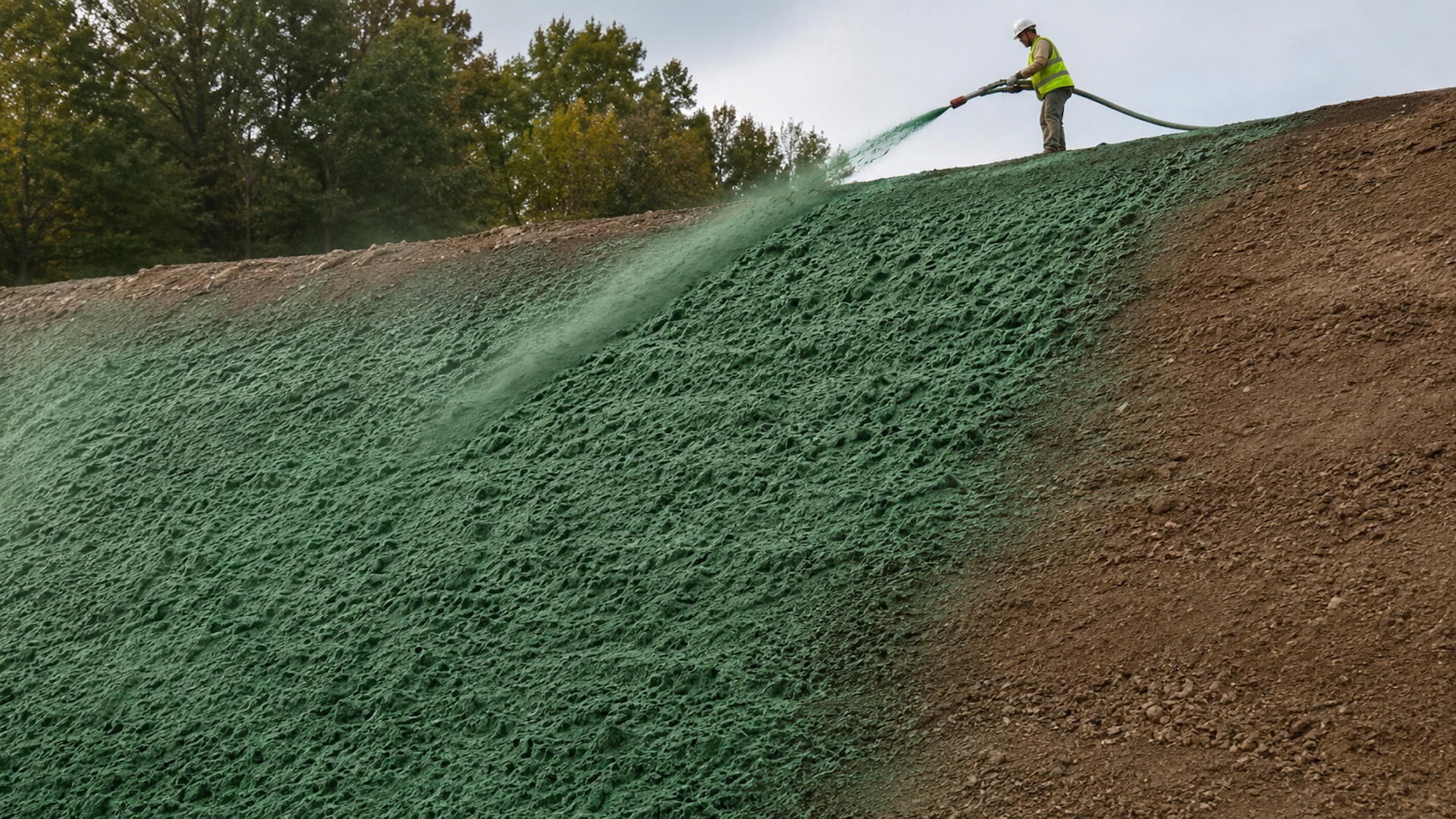
A bonded fiber matrix (BFM) is a hydraulically applied erosion-control product composed of thermally refined wood fibers, cross-linking hydrocolloid tackifiers, and protective binders.
Upon drying, these components chemically bond to create a continuous, highly porous, and water-resistant mat that anchors directly to the soil surface.
Unlike standard hydroseeding mulches that sit loosely on the ground, a BFM physically locks seeds in place, protecting them from rain and foot traffic.
Research indicates that BFM products can reduce soil loss by up to 95 percent compared to bare soil, versus 80 to 85 percent for standard wood fiber mulch, with the performance gap widening significantly on slopes exceeding 3:1 (horizontal: vertical).
In this guide, you’ll learn how BFM products differ from traditional mulch, why they’re recommended for slopes, and how they help you meet Construction General Permit (CGP) and Stormwater Pollution Prevention Plan (SWPPP) guidelines.
What Is Bonded Fiber Matrix (BFM)?
A Bonded Fiber Matrix (BFM) is an advanced hydroseeding mulch designed for superior erosion control, especially on slopes.
While standard hydromulch leaves a loose layer of wood fiber on the ground, a BFM contains special binding agents. As the sprayed mixture dries, these chemicals lock the fibers together and anchor them directly to the dirt, creating a continuous, protective crust.
The BFM Mixtures contain three precise ingredients, blended with water to create a thick slurry:
- Thermally Refined Wood Fibers: This is the bulk of the mix. Unlike standard paper mulch, these wood fibers are treated with high heat and pressure. This process creates longer, kinked fibers that physically intertwine like a web, offering much better surface coverage and strength.
- Cross-Linking Agents (Polymers or Guar Gum): This is the glue that sets BFM apart. These chemical binders react as the mixture dries, creating strong molecular bonds. Instead of just sitting on the dirt, the binders lock the wood fibers together and chemically bind them to the soil surface.
- Water-Absorbing Tackifiers: These are natural or synthetic additives that help the slurry adhere to steep slopes immediately upon application (before it even dries) and help the matrix retain crucial moisture later for seed growth.
When these components dry, they cure into a tough, water-resistant, yet porous blanket that protects the soil while allowing seeds to breathe and grow right through it.
Benefits of Using BFM Mulch for Erosion Control
A BFM protects your site and promotes growth in five key ways:
- Bonds to the Dirt: As it dries, the matrix glues itself to the topsoil. This tight bond stops heavy rain and runoff from washing the soil away.
- Forms a Solid Mat: Instead of loose, scattered fibers, BFM cures into a strong, continuous blanket. This durable mat won’t break apart when rain hits it.
- Protects New Seeds: It locks seeds firmly against the soil so they aren’t washed away, while trapping the perfect balance of moisture and warmth needed for quick germination.
- Absorbs Rain Impact: Heavy raindrops can easily displace bare dirt. A BFM acts as a shock absorber, soaking up the impact energy before it can trigger erosion.
- Lasts Longer: Engineered to withstand multiple severe storms, a BFM protects the slope for 6 to 12 months. This gives slow-growing vegetation plenty of time to establish deep roots.
Many regulators recommend BFM for slopes with a 3:1 pitch due to its superior binding properties that help protect erosion-prone soils from the elements.
How BFM Differs from Standard Hydraulic Mulch
The hydroseeding mulch market includes several distinct product categories, each with distinct erosion-control performance characteristics.
Understanding where BFM fits in this spectrum is essential for selecting the right product for site conditions.
| Mulch Type | Composition | Bonding Mechanism | Slope Suitability | Typical Cover Rate |
|---|---|---|---|---|
| Wood Fiber Mulch (WFM) | Hammer-milled wood fiber | None — loose fiber contact | Up to 3:1 | 1,500–2,000 lb/acre |
| Paper Fiber Mulch | Recycled newsprint/paper fiber | None — loose fiber contact | Up to 4:1 | 1,500–2,000 lb/acre |
| Blended Mulch (BM) | Wood and paper fiber mix | None — loose fiber contact | Up to 3:1 | 1,500–2,000 lb/acre |
| Bonded Fiber Matrix (BFM) | Thermally refined wood fiber + cross-linking agents | Chemical bonding to soil surface | Up to 1:1 (some products) | 2,000–3,500 lb/acre |
| Flexible Growth Medium (FGM) | High-density cross-linked fiber, enhanced polymer binder | High-strength soil bond, textile-like matrix | Near vertical in some specs | 3,500+ lb/acre |
The primary difference between standard wood fiber mulch and a Bonded Fiber Matrix (BFM) depends on the hill’s steepness. The dividing line is typically a 3:1 slope.
- On flatter slopes (less than 3:1): Standard wood fiber mulch works perfectly fine. As long as you apply enough of it, it will protect most soils from erosion.
- On steeper slopes (greater than 3:1, and especially past 2:1): Standard mulch fails because it doesn’t glue itself to the dirt. Without that bond, heavy rain will cause the loose mulch to slide down the hill, scatter, or wash away entirely before your new grass has a chance to grow roots and take hold.
When BFM Outperforms Standard Mulch: Site Conditions and Selection Criteria
BFM is not always the right product. It costs more per acre than standard wood fiber mulch, requires higher application rates, which slow the hydroseeding process, and, on flat or gently sloping sites with moderate soil erodibility, its bonding performance provides only marginal improvement over standard mulch.
Choosing BFM is an engineering judgment based on site conditions.
Opt for a Bonded Fiber Matrix when your project involves:
- Steep Slopes (Greater than 3:1): Gravity and heavy rain will cause standard mulch to slide down steep hills. BFM chemically adheres to the slope, easily handling the added stress. (Many states actually require BFM or an equivalent for slopes steeper than 3:1 or 2:1).
- Highly Erodible Soils: Loose, sandy, silty, or deeply excavated construction subsoils break apart easily when exposed to rain. BFM physically reinforces these weak soils at the surface so they can’t wash away.
- Slow-Growing Vegetation: If you are seeding late in the season, using slow-germinating seeds, or facing harsh growing conditions, standard mulch will break down too quickly. BFM lasts 6 to 12 months (compared to just 3 to 6 months for regular mulch), protecting the dirt until roots take hold.
- Drainage Channels and Runoff Paths: Standard mulch quickly washes out in drainage swales and in areas where rainwater pools and accelerates. BFM resists the forces of rushing water, making it ideal for low-velocity channels and runoff transition zones.
- Sites Near Sensitive Waterways: If your job site discharges near protected rivers, lakes, or streams, you face strict regulatory penalties for muddy runoff. BFM provides the superior containment needed to keep nearby waters clear and keep your project in legal compliance.
How to Apply BFM to Soil
To apply a Bonded Fiber Matrix (BFM), mix the dry product with water, seed, and fertilizer in a standard hydroseeder and agitate for 15 to 30 minutes to activate the chemical binders.
Spray the thick slurry at a rate of 2,000 to 3,500 lbs per acre, using overlapping passes to ensure total coverage.
Finally, allow 24 to 48 hours of dry weather above 40°F for the matrix to cure and bond to the soil fully.
Because BFM mixes into a much thicker slurry than standard wood mulch, it requires careful preparation and scheduling.
BFM and SWPPP Compliance
Under the EPA’s Construction General Permit (CGP), a Bonded Fiber Matrix is an approved Best Management Practice (BMP) for temporary soil stabilization.
The permit requires bare, inactive soil to be stabilized within 14 days, aiming for at least 70% ground cover.
While standard mulch often washes away and fails to meet this requirement on steep or highly erodible slopes, a BFM provides the heavy-duty performance needed to stay compliant.
Just remember to document your specific reasons for choosing a BFM in your SWPPP, and have inspectors check for any cracking or undercutting after major rainstorms so repairs can be made quickly.
By understanding exactly when and how to deploy a Bonded Fiber Matrix, you can protect your site’s challenging slopes, ensure rapid vegetation growth, and keep your project fully compliant with environmental regulations.
Frequently Asked Questions
What is bonded fiber matrix hydroseeding?
It is a method in which seed, fertilizer, and a specialized wood-fiber mulch are mixed with water and sprayed onto the ground in a single step. Unlike regular mulch that sits loosely on the dirt, this mix contains glue-like binders that dry into a solid, protective mat to stop severe erosion.
When should BFM be used instead of standard hydromulch?
Use BFM on steep hills (steeper than a 3:1 slope), loose or sandy soils that wash away easily, or projects near protected waterways where muddy runoff faces heavy fines. For flat or gentle lawns, cheap standard wood mulch works fine.
What slope gradients can BFM handle?
BFM is built for steep hills ranging from 3:1 to 1:1 (45-degree) slopes. For near-vertical cliffs, you would upgrade to a tougher product called Flexible Growth Medium (FGM).
How long does BFM last before it needs to be reapplied?
It protects the soil for 6 to 12 months, twice the lifespan of standard mulch. If you spray in the spring, your new grass will usually grow in before the BFM wears off. If you spray in the late fall, it will shield the bare dirt all winter until spring growth starts.
Does BFM prevent seeds from germinating?
No, it actually helps seeds grow. The continuous mat locks the seeds tightly against the dirt so they can’t wash away, while trapping the perfect amount of moisture and warmth underneath. It also shields fragile new sprouts from being crushed by heavy raindrops.