
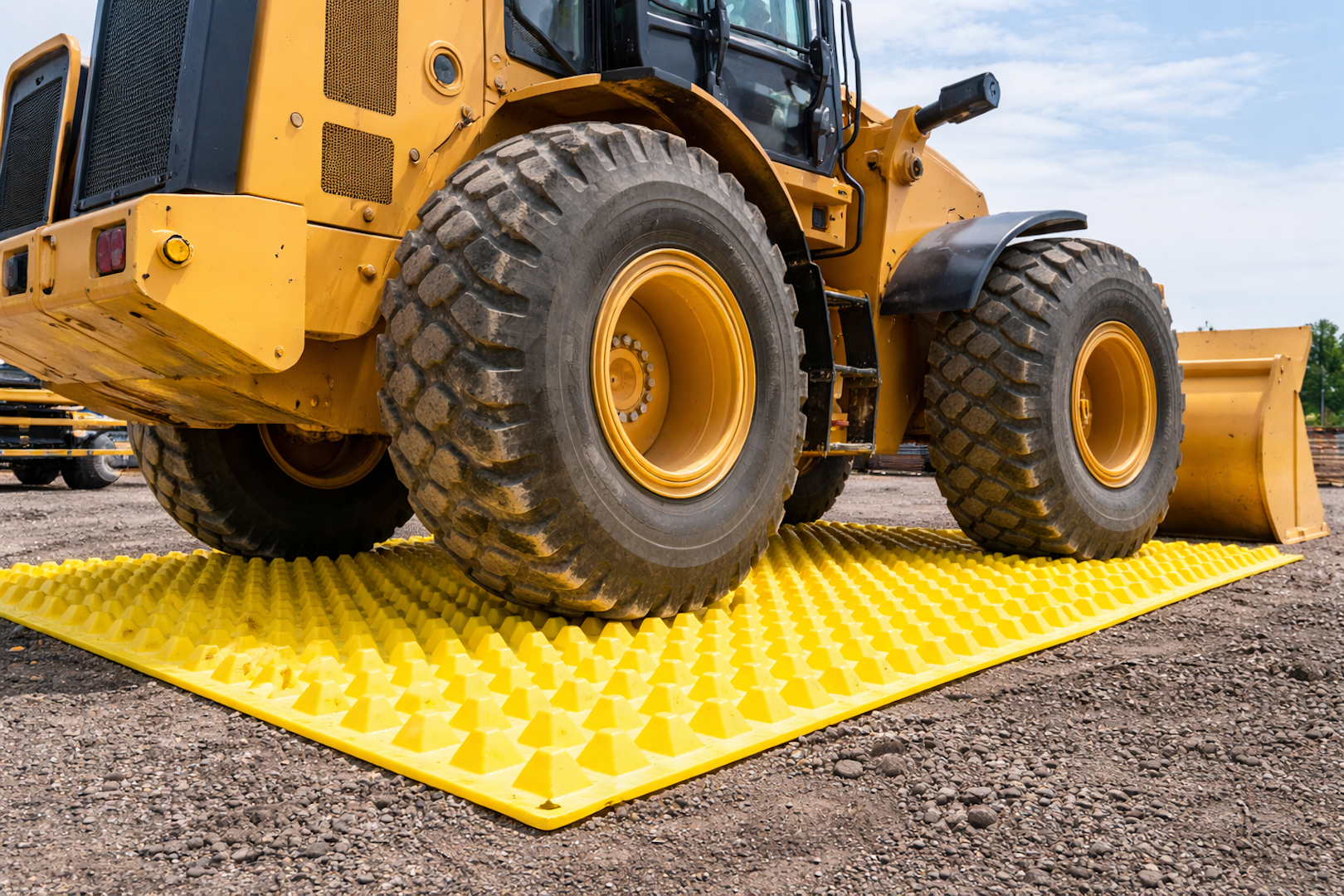
Construction sites generate massive amounts of debris daily, but the most significant environmental threat often leaves the site on four wheels. Track out—the mud, sediment, and concrete dust hitched to vehicle tires—quickly spreads from job sites to public roads, where it creates hazardous driving conditions and contributes to severe air and water pollution.
To combat this, various track out controls act as a critical line of defense. Track out mats use specialized surface grids to physically “shake” and scrub tires, trapping sediment within the mat rather than the street. When paired with tire-washing stations and stabilized entrances, these systems remove pollutants at the source, ensuring that site runoff doesn’t clog local storm drains or degrade community air quality.
This guide explains how to implement these controls effectively, why they are essential for regulatory compliance, and how they protect the health of the surrounding environment.
What Is Construction Track Out?
Track out is sediment, mud, or debris that vehicles carry from construction sites onto paved roads. It occurs at exit points where construction vehicles transition from unpaved work areas to public streets.
The problem extends beyond visible dirt on roads. Track out includes fine particles that become airborne, contaminating nearby air quality. It also washes into storm drains during rain, polluting local waterways with sediment and construction chemicals.
Most municipalities require track out controls under stormwater management regulations. The EPA’s Construction General Permit mandates sites disturbing one acre or more to implement measures to prevent sediment from leaving the property.
Why Track Out Controls Matter for Environmental Protection
Track out controls prevent site-specific pollutants from harming the local environment outside the construction site. Track out controls prevent environmental pollution in the following ways:
Air Quality Protection
Track out creates particulate matter (PM10 and PM2.5) pollution. When vehicles drive over dried mud on roads, they pulverize it into fine dust that becomes airborne.
This matters because particulate pollution causes respiratory issues, especially among children and older adults near construction zones. The EPA identifies particulate matter dust from construction sites as a significant contributor to urban air quality problems.
Track out controls reduce airborne pollution by keeping sediment contained at the source. Construction track out mats trap particles before they reach paved surfaces, where vehicles can aerosolize them.
Water Quality Protection
Sediment is the number one pollutant in U.S. waterways by volume, according to the EPA. Construction sites are major contributors to sediment from land disturbance activities.
Track out sediment washes into storm drains during rain events, which carries:
- Heavy metals from equipment and materials
- Petroleum products from vehicle leaks
- Alkaline compounds from concrete
- Chemical additives from construction products
These pollutants flow directly into streams, rivers, and lakes. Most storm drain systems lack treatment facilities, meaning everything washed from roads enters waterways untreated.
Construction track out mats prevent this cycle by stopping sediment at the exit point. They capture particles before vehicles spread them across roads, where rain can mobilize them.
Community Health and Safety
Track out creates immediate hazards, such as reduced vehicle traction. Dust also reduces visibility and triggers asthma and allergy symptoms in nearby residents.
Local communities often file complaints about construction dust and debris. These complaints can lead to stop-work orders, fines, and project delays.
You protect community relations by implementing effective controls. Visible track out control measures show neighbors you’re taking environmental responsibility seriously.
How Construction Track Out Mats Work
Construction track out mats are stabilized surfaces placed at construction site exits. They remove sediment from vehicle tires and undercarriages before vehicles reach public roads.
Physical Design and Function
Most track out mats use one of two designs:
- Aggregate-based pads consist of crushed stone (typically 1-3 inches in diameter) laid 6-12 inches deep over geotextile fabric. The stone’s angular surfaces scrape debris from tires as vehicles drive across.
- Manufactured rumble mats feature raised patterns or ridges that agitate tires and dislodge sediment. These come in steel, concrete, or heavy-duty polymer materials.
Both types work through mechanical action. As tires roll across the textured surface, the vibration and scraping motion knocks loose particles free. The mat surface then traps these particles instead of letting them continue onto paved roads.
Minimum Size Requirements
The EPA and most state regulations require track out control areas of at least 50 feet in length. This distance ensures vehicles make multiple tire rotations across the cleaning surface.
Wider is always better. Pads should span the full width of the exit route plus 10 feet on each side. This prevents vehicles from bypassing the control by driving around edges.
Placement and Maintenance
Position track out mats at every point where vehicles transition from unpaved to paved surfaces. This includes main exits, material-delivery entrances, and equipment-staging-area access points.
Maintenance determines effectiveness, so always:
- Inspect mats daily for sediment accumulation
- Remove accumulated material when it reaches a depth of 2 inches
- Replace or replenish aggregate when it becomes smooth
- Repair damaged sections immediately
Failed maintenance compound pollution–vehicles drive through accumulated sediment and spread it more widely.
Additional Track Out Control Methods
Construction track out mats work best as part of an integrated system of controls. Combine them with these supplementary controls for maximum efficacy:
Tire Washing Stations
Wheel wash systems use high-pressure water jets to remove stubborn mud from tires and undercarriages. They’re essential for sites with wet, clay-heavy soils that mat systems alone can’t adequately clean.
We install tire wash stations after track out mats, creating a two-stage cleaning process. Mats remove bulk material, then washing removes the remaining adhesive particles.
Then we recirculate wash water through settlement tanks. This prevents sites from simply moving the pollution problem from roads to storm drains.
Street Sweeping Programs
Commercial street sweeping removes sediment that escapes other controls. This matters because even well-maintained systems don’t achieve 100% effectiveness.
Schedule sweeping for early morning before traffic pulverizes dried sediment into airborne dust. Use vacuum-assisted sweepers rather than traditional broom sweepers—they capture fine particles more effectively.
Document your sweeping schedule. Regulators view consistent sweeping as evidence of good faith compliance efforts, even if some track out occurs.
Stabilized Construction Entrances
Pave or apply chemical stabilizers to the first 100 feet of roadway inside your site perimeter. This reduces the amount of loose material available for vehicles to pick up in the first place.
The geotextile fabric underneath prevents stabilized surfaces from mixing with underlying soil. This maintains the integrity of your entrance under repeated heavy-vehicle traffic.
Track Out Compliance Requirements and Regulations
Construction projects must adhere to a multi-tiered regulatory framework, starting with the EPA’s NPDES Construction General Permit, which mandates track out controls for sites disturbing one acre or more.
These requirements must be detailed in your Stormwater Pollution Prevention Plan (SWPPP) and are subject to rigorous inspections. Because state and local agencies often enforce stricter standards based on regional environmental concerns, compliance requires a proactive approach to both federal law and local municipal codes.
- Federal Oversight: The EPA can impose fines of up to $58,328 per violation per day under the Clean Water Act.
- Stricter Local Standards: Some regions, such as certain air quality districts in California, trigger requirements for sites as small as one-quarter acre.
- Operational Risks: Beyond monetary fines, inadequate controls can result in stop-work orders, causing project delays that often far exceed the cost of the control systems themselves.
- Compliance Verification: Inspectors verify that the specific measures identified in your SWPPP are effectively implemented and maintained throughout the project lifecycle.
Choosing the Right Track Out System for Your Site
Selecting the most effective track out solution requires balancing your project’s physical demands with regulatory requirements and long-term budget goals.
Site-Specific Factors
- Soil Type: This determines which system works best. Clay soils require more aggressive cleaning than sandy soils. Wet sites often need tire washing stations, while dry sites may succeed with aggregate pads alone.
- Traffic Volume: High-traffic sites with 50+ vehicle trips daily require more robust systems and more frequent maintenance than low-traffic residential sites.
- Budget Constraints: Aggregate pads typically cost $2,000–$5,000 for standard installation, while manufactured rumble mats run $5,000–$15,000. Comprehensive tire wash stations start around $20,000.
Cost-Benefit Analysis
- Risk Mitigation: Compare control costs against potential penalties. A $5,000 track out system is a minor investment compared to a $58,328 EPA fine or a multi-week stop-work order.
- Community Relations: Controlling track out prevents neighbor complaints, which can protect your reputation and prevent delays in future permitting.
- Cleanup Savings: Effective controls significantly reduce the labor costs associated with manually removing dried mud and debris from public roadways.
Construction track-out is a significant contributor to air and water pollution and carries significant regulatory and financial risks.
By implementing the right combination of track out mats, tire wash stations, and stabilized entrances, project managers can protect community health, stay compliant with EPA standards, and avoid the staggering costs of environmental violations.
Investing in high-quality track-out controls today ensures a cleaner, safer, and more efficient job site throughout your project.
CTA
Frequently Asked Questions
What size should construction track out mats be?
Minimum 50 feet long and wide enough to span the entire exit route plus 10 feet on each side. Larger sites with heavy traffic should use 75-100 foot lengths for better cleaning effectiveness.
How often should track out mats be cleaned?
Inspect daily and remove sediment when accumulation reaches a depth of 2 inches. Clean more frequently during wet conditions when tracking increases.
Do I need track out controls for small projects?
Federal regulations require controls for sites disturbing one acre or more. Many states and municipalities have lower thresholds. Check local requirements regardless of project size.
Aggregate pads or rumble mats better?
Aggregate pads cost less and work well for most conditions. Rumble mats perform better in wet conditions and require less maintenance, but cost more upfront.
How much do construction track out mats cost?
Aggregate-based systems cost $2,000-$5,000 installed. Manufactured rumble mats run $5,000-$15,000. Costs vary based on size, material, and site conditions.
Can I reuse track out mats on multiple projects?
Manufactured rumble mats are reusable. Aggregate pads typically aren’t worth relocating due to labor costs, though you can recycle the stone for other site uses.
What happens if sediment still escapes despite controls?
Implement supplementary measures such as tire-washing stations or more frequent street sweeping. Document your response to show good faith compliance efforts.
CTA