
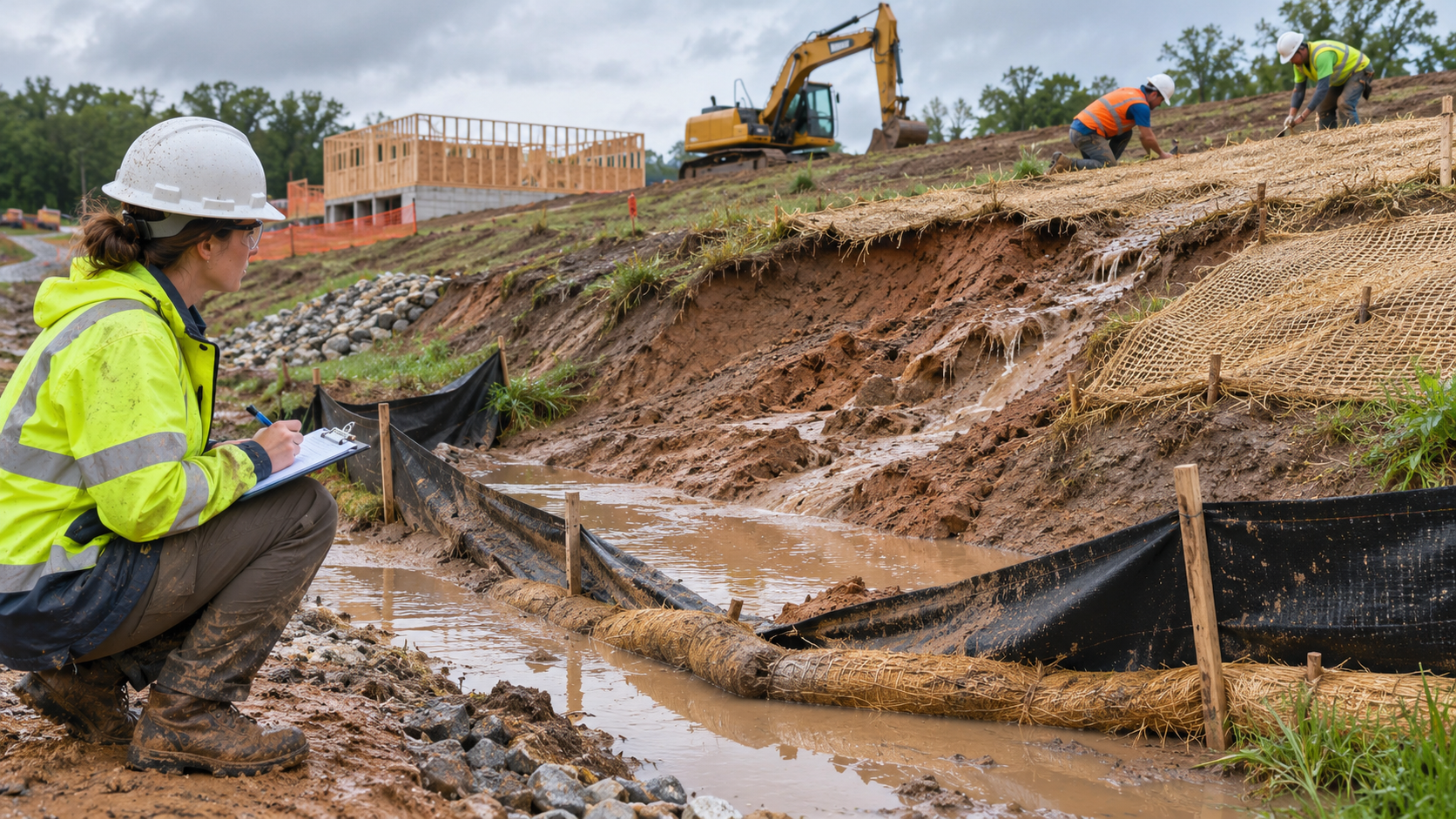
Storm washout remediation is the process of restoring a construction site after heavy rain or severe weather washes away soil, damages grading, or compromises prepared surfaces.
After a stormwater washout, it’s imperative to stop ongoing sediment loss, conduct a full post-storm inspection, and update your Stormwater Pollution Prevention Plan (SWPPP) before resuming activities.
Without proper remediation, erosion, standing water, and unstable soil can create additional delays and compromise the integrity of future construction.
Knowing how to respond to storm damage quickly can help get your site back on track while preventing the same problems from happening again.
In this article, we’ll explain step by step what to do after a storm washout, how to evaluate site damage, and which remediation strategies can restore site conditions and protect your project from future rainfall.
Step 1: Stop Ongoing Sediment Loss Before Resuming Activity
When a storm breaches site controls, your first job is stopping active off-site sediment loss. Walk your downslope boundary immediately to spot where dirty runoff is escaping toward streets, storm drains, or waterways.
Some quick-deploy stabilization tactics that you can use with on-hand materials include:
- Temporary wattles or coir logs: Stake straw wattles or coir rolls across active flow channels without trenching to slow runoff velocity and trap sediment while long-term repairs are underway.
- Sandbag inlet berms: Stack sandbags upstream of vulnerable storm inlets to block sediment entering displaced inlet filters.
- Emergency silt fence resets: If fabric has pulled free or stakes have collapsed, fold the fence back toward the upslope side and pin it flat to create a temporary check dam across the breach.
- Straw bale check dams: Stake straw bales in concentrated flow paths to reduce water speed and drop heavy sediment.
Emergency stabilization stops active environmental discharge so you can safely assess full site damage without triggering immediate enforcement actions.
Step 2: Conduct a Full Post-Storm Inspection and Document Everything
The EPA’s Construction General Permit requires a site inspection within 24 hours of any precipitation event of 0.25 inches or greater.
Beyond compliance, detailed documentation protects your site against Notice of Violation (NOV) claims by demonstrating proactive management.
- BMP conditions: Log whether each control is functional, damaged, or failed. Take timestamped photos at every location to build a clear compliance record.
- Discharge evidence: Inspect downslope areas, curb lines, and adjacent waterways for turbid runoff, mud tracking, or sediment plumes. Off-site discharges often trigger mandatory agency notification under state or EPA guidelines.
- Failure root cause: Note whether failures stemmed from capacity limits (storm exceeded BMP design), installation defects, or delayed routine maintenance.
- Altered drainage paths: Identify new channels, eroded swales, or blocked pathways created by high-volume runoff across disturbed soil.
Attach field notes and photos directly to your SWPPP inspection report to keep your compliance log audit-ready.
Step 3: Prioritize Repairs by Risk, Not by Convenience
Avoid repairing controls based on physical convenience. Instead, allocate field crews using a hydrologic risk-priority structure focused on water-quality threats.
We’ve developed a practical risk-prioritization framework for construction managers to evaluate:
| Priority | Condition | Action Timeline |
| Immediate | Active sediment discharge to waterway or storm drain inlet with no functional control in place | Same day — before any additional earth disturbance resumes |
| High | Perimeter controls breached at site boundary with direct discharge pathway to public ROW or waterway | Within 24 hours — repair or replace before next forecast precipitation |
| Elevated | Controls damaged but partially functional; no active discharge but risk of discharge in next storm | Within 48 hours or before next forecast precipitation event, whichever is sooner |
| Routine | Controls intact but sediment pool at capacity; minor maintenance deficiencies with no immediate discharge risk. | By next scheduled inspection date per CGP requirements |
For each repair, you need to understand why the original control failed before you reinstall the same thing in the same place.
A silt fence that overtopped repeatedly is telling you the drainage area it was assigned to is too large for that control type.
Reinstalling the same control without addressing the root cause means you will face the same failure in the next storm.
Schedule My Expert SWPPP Consultation Today
Step 4: Repair and Reinstall Erosion Control Barriers Correctly
Erosion control barriers are only as effective as their installation. The post-storm repair period is an opportunity to correct installation deficiencies that may have contributed to the original failure
Silt Fence Reinstallation
Silt fence is the most common perimeter control on construction sites and also the most commonly installed incorrectly. A silt fence that is simply stapled to stakes and pushed into the ground surface will fail in the first storm with any real runoff velocity. Proper reinstallation requires:
- Trench installation: The bottom 6 to 8 inches of fabric must be buried in a trench and backfilled with compacted soil. This anchors the fence against the hydraulic pressure of ponded water and prevents flow from undermining the barrier.
- Stake spacing matched to drainage area: Standard stake spacing is 6 to 10 feet on flat ground, but slopes and concentrated flow areas require closer spacing to prevent the fabric from billowing and tearing away from the stakes under load.
- J-hook terminal ends: Turn the terminal ends of each silt fence run upslope 2 to 3 feet in a J-hook configuration to prevent runoff from routing around the end of the fence rather than through it.
- Drainage area limits: A single silt fence run should not control a drainage area of more than 0.25 acres per 100 linear feet. If your original fence was controlling a larger area and overtopped, the repair needs to include either a supplemental control upgrade or a redesign of the drainage management approach for that area.
Wattle and Fiber Log Replacement
Straw wattles and coir fiber logs are installed on contour, perpendicular to the slope, not parallel to it.
Stake each wattle at 4-foot intervals, driving the stake through the wattle body and into the soil at an angle to resist pullout.
On slopes steeper than 3:1, trenching the wattle into a shallow trench (3 to 4 inches) prevents flow from routing beneath it.
Wattles and fiber rolls have finite service lives that are accelerated by storm events. Any wattle that has been displaced, punctured, or compressed below 50 percent of its original diameter should be replaced, not repositioned.
Inlet Protection Repair and Upgrade
Storm drain inlets that received sediment-laden flow during the washout event need cleaning before inlet protection is reinstalled.
Sediment that entered the inlet during the storm is now in the storm drain system. Contact the local municipality or stormwater authority if you believe sediment reached the main storm drain line.
For the reinstalled inlet protection, consider whether the original device type was appropriate for the flow volumes at that inlet.
High-volume inlets adjacent to large disturbed areas need heavy-duty curb inlet protection systems or rock filter dams.
Step 5: Update Your SWPPP Before Restarting Earth Disturbance
Every significant storm event that causes BMP failure, discharge, or changes to site drainage patterns requires a SWPPP update.
This is a permit requirement under the Construction General Permit and good practice that protects the operator from enforcement exposure.
Your post-storm SWPPP update should include:
- Documented failures & actions: Details on failed BMPs and exact corrective measures taken.
- Discharge details: Estimated discharge volume, duration, dates, and affected receiving waters.
- Site map adjustments: New flow paths, adjusted grading, or relocated control measures.
- BMP design changes: Engineering upgrades if original controls proved under-designed for site topography or flow volume.
- Subcontractor additions: Any specialized spill response or repair contractors brought on-site.
Earth-disturbing activities should not resume in areas where BMP repairs are incomplete. The SWPPP must accurately reflect current site conditions at all times, not anticipated future conditions when repairs are finished.
What Counts as an Adequate Erosion Control Barrier for Post-Storm Conditions
One of the most common questions after a storm washout is whether the same controls that failed can be reinstalled, or whether the event demonstrates that a higher-performing system is required.
The answer depends on whether the failure was an exceedance failure or an installation failure.
An exceedance failure occurs when a storm event produces runoff volumes that exceed the design capacity of a properly installed control. The control performed as designed but was overwhelmed by an event larger than its design storm.
In this case, the appropriate response is to evaluate whether a higher-capacity control is needed.
An installation failure occurs when a control fails at a storm intensity it should have handled because it was improperly installed or deployed in a configuration that did not match site conditions. In this case, reinstallation with correct specifications is the appropriate response.
Distinguishing between the two matters for your SWPPP update and for your exposure in any subsequent regulatory review. Document your analysis in the corrective action section of your inspection report.
FAQs
How quickly do I need to repair erosion control barriers after a storm?
The Construction General Permit requires that deficiencies identified during inspections be corrected before the next scheduled inspection or by a date specified in the corrective action section of the inspection report (whichever is sooner). For deficiencies that pose an immediate risk of discharge to a waterway or storm drain, same-day corrective action is appropriate. Waiting until the site dries out is not a compliant response when controls are actively failing.
Do I need to notify the EPA or state agency if sediment reached a waterway during the storm?
Notification requirements vary by state and by permit. Under the federal CGP, discharges that cause or contribute to violations of water quality standards must be reported and corrected. Review your state permit’s reporting requirements and contact your permit authority if you have evidence that sediment reached a receiving water during the event.
Can I restart earth disturbance before all BMP repairs are complete?
Not in areas where BMP repairs are incomplete. You can resume work in areas of the site where controls are confirmed to be functional, and the SWPPP accurately reflects current conditions. Any area where controls have failed and have not been repaired is an area where earth disturbance should not resume.
How do I know if my silt fence was installed correctly before the storm?
A properly installed silt fence has its fabric buried in a 6-to-8-inch trench and is anchored with stakes at appropriate intervals to withstand standard storm conditions. If your fence routinely collapses or blows out during moderate rain, it was likely installed incorrectly and needs to be reset using proper trenching and staking techniques.
What is the difference between erosion control and sediment control?
Erosion control prevents soil from detaching and washing away in the first place. Key methods include surface stabilization (seeding, mulching, erosion control blankets) and minimizing ground disturbance. Sediment control traps soil that has already been detached and mobilized by runoff before it leaves the site. Key methods include silt fences, wattles, sediment basins, and inlet protection.