
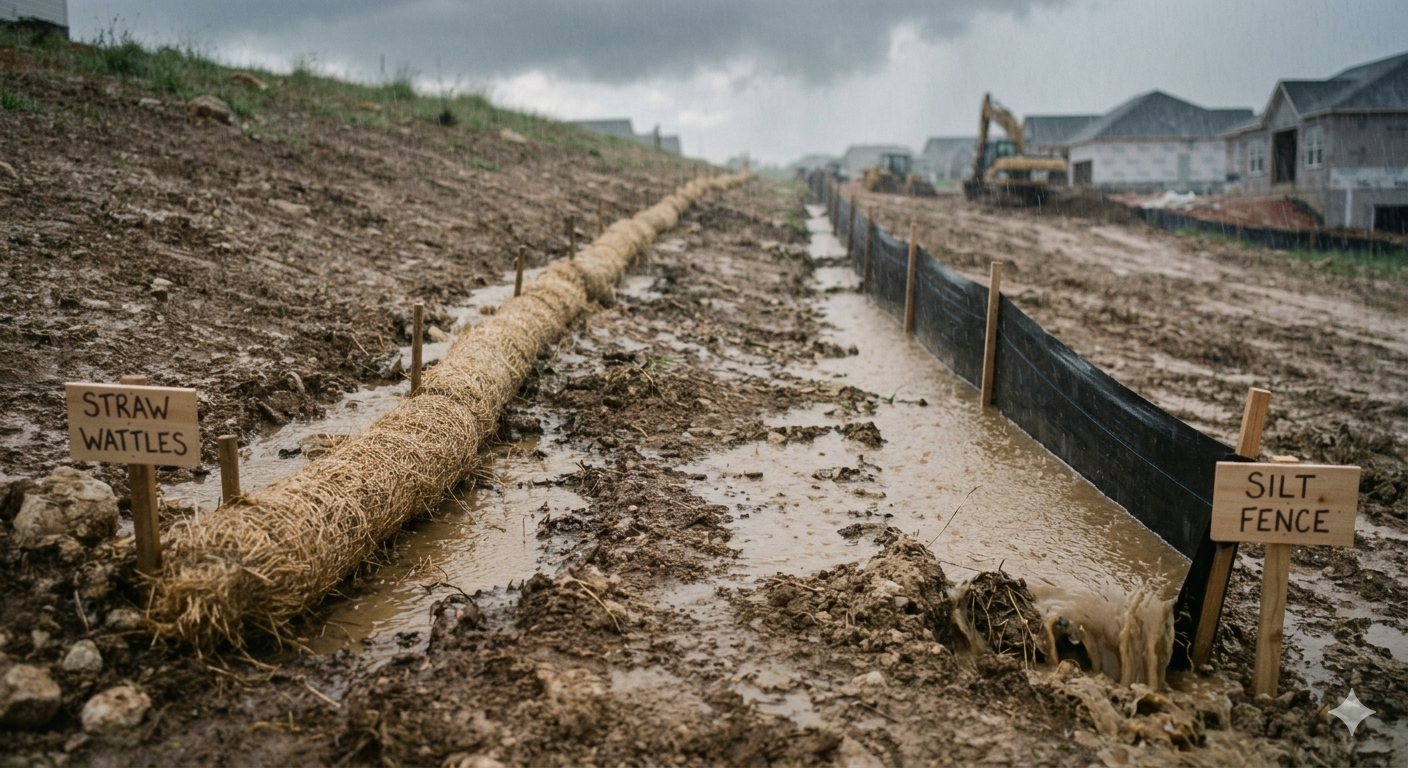
Erosion control wattles outperform silt fences on steep slopes, rocky or irregular terrain, and low-velocity drainage channels where trenching a fence is impractical or prohibited.
While silt fences provide higher sediment storage on flat perimeters, wattles offer superior flexible ground contact, reduce runoff velocity, and biodegrade in place to eliminate removal costs.
Both wattles and silt fences are sediment control BMPs required under EPA’s Construction General Permit and recognized in NRCS erosion control practice standards.
Our field technicians prescribe the optimal BMP based on slope gradient, hydraulic flow velocity, terrain geometry, and soil stability.
In this guide, you’ll learn how wattles and silt fences compare, when to deploy each barrier for maximum performance, and how to execute proper installation to maintain regulatory compliance.
What Are Erosion Control Wattles?
Erosion control wattles—also known as fiber rolls or straw logs—are cylindrical sediment barriers designed to intercept sheet flow, reduce runoff velocity, and trap sediment on disturbed slopes.
Typically measuring 9 to 12 inches in diameter and filled with compressed straw, coir, or wood fiber, they conform closely to natural terrain without requiring soil trenching.
Wattles work through three primary mechanisms:
- Velocity Reduction: They break up long slopes, slowing stormwater runoff to prevent rill and gully erosion.
- Flow Filtration: Water filters through the porous natural fiber matrix while suspended sediment settles out on the upslope side.
- Soil Stabilization: As natural-fiber wattles biodegrade in place over 1 to 3 years, they decompose into organic matter that fosters vegetative growth and long-term ground stabilization.
Unlike silt fences, wattles are flexible, conform to irregular terrain, and are biodegradable, simplifying removal at cleanup.
What Is Silt Fence?
Silt fence is a woven geotextile fabric stretched between driven wooden or metal stakes along the downslope perimeter of a disturbed area.
It works by impounding sheet-flow runoff long enough for sediment to settle out of suspension before relatively clean water passes through the fabric.
Silt fence is designed exclusively for sheet flow; it is not a dam, it is not rated for channel flow, and it will overtop, undercut, or fail structurally if concentrated flow is directed at it.
Silt fence is the most widely specified sediment control BMP on construction sites because it is inexpensive and straightforward to install on appropriate terrain.
On flat to moderately sloped sites with intact soil, silt fences provide reliable sediment filtration.
Wattles vs. Silt Fence: Side-by-Side Comparison
The following table compares environmental factors to help site managers determine the proper BMP for their site.
| Erosion Control Wattles | Silt Fence | |
| Purpose | Intercepts and slows flow; filters through fiber matrix | Impounds sheet flow; sediment settles in ponded water |
| Slope suitability | Effective on slopes up to 2:1 (H:V); used on steeper slopes where silt fence cannot be installed | Effective on slopes up to 3:1; fails on steeper or irregular terrain |
| Terrain requirements | Conforms to irregular terrain; no flat installation surface required | Requires relatively flat, straight alignment; poor on uneven ground |
| Flow type | Sheet flow and low-velocity channel flow | Sheet flow only; fails under concentrated or channel flow |
| Installation | Staked at 4-foot intervals perpendicular to slope; no trench required | Stakes at 10-foot max intervals; bottom 6 inches trenched and backfilled |
| Concentrated flow | Check dam configuration handles low-velocity concentrated flow | Will overtop, undercut, or blow out |
| End of project | Biodegrades in place; no removal required | Must be removed and disposed of |
| Sediment accumulation | Lower sediment impoundment; sediment trapped in fiber matrix | Requires periodic cleanout when sediment reaches 1/3 to 1/2 fence height |
| Revegetation benefit | Traps seeds and organic matter; accelerates vegetative establishment | No revegetation benefit |
| Typical cost | Higher material cost; lower labor cost on steep or irregular terrain | Lower material cost; labor-intensive installation on poor terrain |
When Wattles Outperform Silt Fence
Erosion control wattles outperform silt fences in complex field environments where slope steepness, irregular ground contours, concentrated low-velocity flows, or environmental restrictions prevent proper silt fence trenching and anchoring.
While silt fences excel on long, flat perimeters, wattles offer greater adaptability and better velocity reduction across challenging terrain.
- Steep Slopes (1.5:1 to 3:1): Wattles stabilize steep slope faces where silt fence staking is impractical and high runoff velocities exceed fabric limits.
- Rocky and Irregular Terrain: Their flexible design conforms to roots, rocks, and uneven contours without leaving the undersurface gaps that cause silt fence blowouts.
- Channels and Swales: Configured as check dams in low-velocity swales, wattles safely reduce water velocity and filter runoff; this use is explicitly prohibited for silt fences under CGP guidance.
- Environmentally Sensitive Sites: Hand-staked wattles minimize soil disruption and offer a fully biodegradable alternative to heavy trenching and plastic fence disposal.
When Silt Fence Is the Better Choice
Silt fence remains the right choice on flat to moderately sloped sites with regular terrain and cohesive soil where the installation requirements can be met correctly.
Silt fence also provides a larger sediment impoundment capacity per unit length than wattles;the ponded water behind a functioning silt fence allows sediment to settle from a larger water volume than the filtration capacity of a wattle’s fiber matrix alone.
For long perimeter runs on flat sites, properly installed silt fences are the more cost-effective option. The lower material cost per linear foot makes silt fence the economical choice for these applications, and the larger settling capacity handles the higher sediment loads that large contributing areas generate.
How to Properly Install Wattles on Workzones
Proper installation is essential for erosion control wattles to slow runoff and filter sediment effectively. According to NRCS Practice Standard 638, installing wattles requires five key steps:
- Trench the Base: Dig a shallow trench 2 to 3 inches deep across the slope, ensuring the bottom third of the wattle rests below grade to prevent runoff from piping underneath.
- Align to Contour: Position the roll perpendicular to the slope contour—never diagonal to flow—so runoff distributes evenly along the full length rather than concentrating at the low end.
- Anchor Securely: Drive 18- to 24-inch wooden stakes directly through the center of the roll at 4-foot intervals, angling them slightly upslope to better withstand impounded water pressure.
- Turn Up the Ends: Curve both ends 12 to 18 inches uphill (“smiling”) to prevent stormwater from flowing around the sides.
- Overlap Intersections: Abut adjacent wattles tightly end-to-end without leaving gaps, or overlap the ends by at least 6 inches to maintain a continuous sediment barrier.
Choosing between erosion control wattles and silt fences comes down to site-specific conditions.
Wattles excel on steep, irregular, and sensitive terrains, whereas silt fences provide maximum sediment capture on long, flat perimeters.
For help choosing the right site-specific BMPs, consult the help of an SWPPP consultant.
FAQs
What are erosion control wattles?
Erosion control wattles are cylindrical rolls of compressed straw, coir fiber, or wood excelsior, typically 9 to 12 inches in diameter, staked perpendicular to slope contours to intercept sheet flow and reduce runoff velocity. They slow runoff, filter suspended sediment through the fiber matrix, and trap sediment on the upslope side of the roll. They are recognized by NRCS Practice Standard 638 and are an accepted BMP under EPA’s Construction General Permit.
When should wattles be used instead of a silt fence?
Wattles work best on slopes steeper than 3:1 where trenching a silt fence is impractical. They are also ideal for rocky or irregular ground where trenching is impossible, low-velocity channels or swales where silt fences are prohibited by stormwater regulations, and sensitive sites requiring minimal soil disturbance.
Do erosion control wattles need to be removed after construction?
Biodegradable wattles made of straw or coir break down in place over one to three years, adding organic matter to the soil as plants grow. Synthetic or polypropylene-netted wattles typically require removal and disposal based on local project specs. Using biodegradable options eliminates the extra labor and disposal burden associated with silt fences.
Can wattles replace silt fences everywhere?
No, wattles hold less sediment per linear foot than silt fences. Silt fences are necessary for long, flat, or gently sloping perimeters with high sediment runoff. The right choice depends on slope steepness, terrain, flow type, and total drainage area rather than product preference.
What is the difference between a wattle and a fiber roll?
They are the exact same product. “Wattle,” “fiber roll,” “straw wattle,” and “straw roll” all refer to cylindrical rolls of compressed natural fiber. Terminology varies by region and material, such as wheat straw, coconut coir, or wood excelsior, but all follow NRCS Practice Standard 638 to slow runoff and filter sediment.