
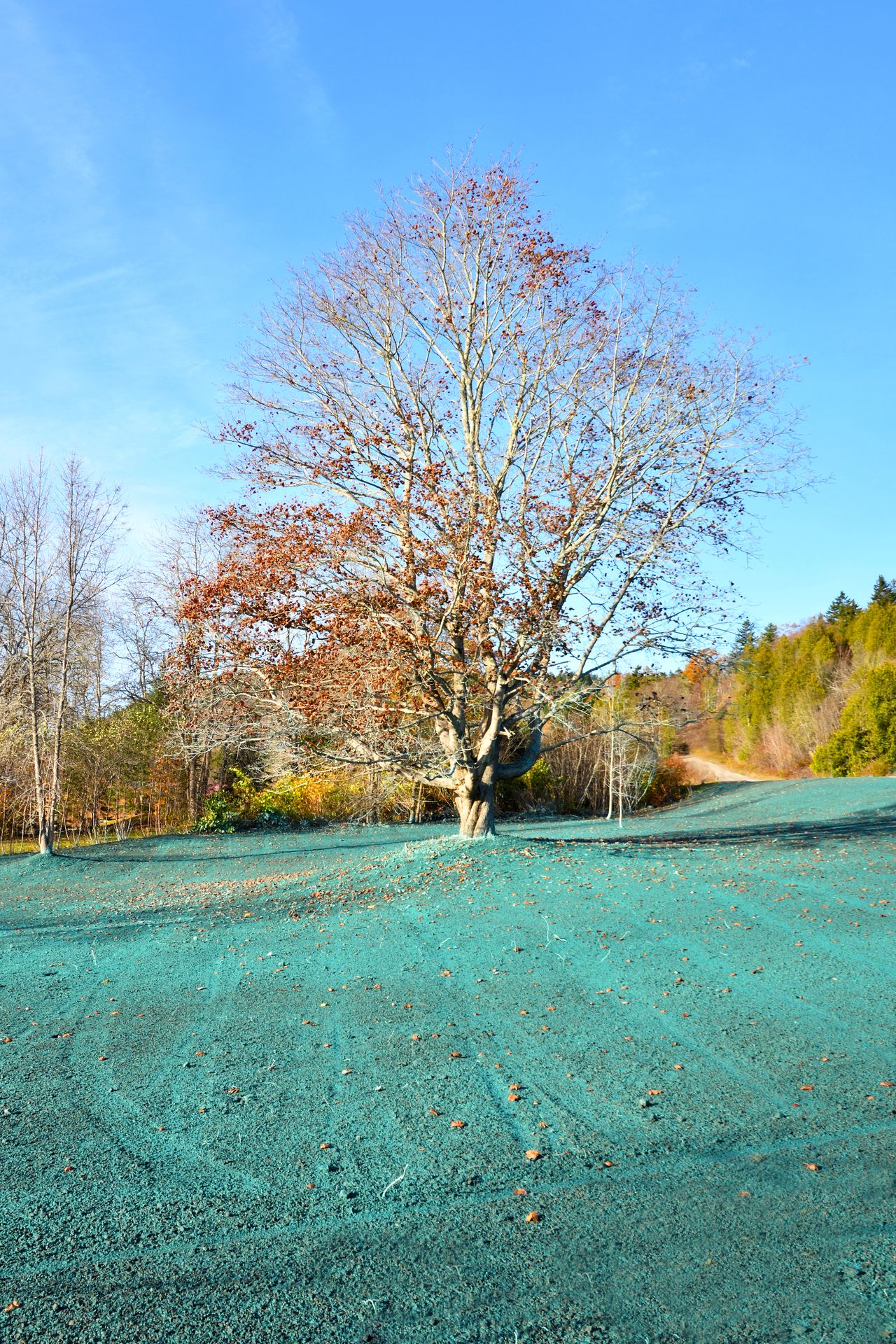
Establishing sustainable vegetation on large-scale commercial sites often presents a significant challenge due to irregular terrain, steep slopes, and strict environmental deadlines.
Traditional dry seeding methods frequently fail to provide the uniform coverage or immediate erosion protection required to prevent costly soil loss and regulatory violations.
Hydroseeding offers a high-performance alternative by applying a specialized slurry of seed, mulch, and nutrients that bonds directly to the soil surface.
This guide explores the key advantages of hydroseeding, from its superior germination rates and cost-efficiency to its role in maintaining SWPPP compliance.
By leveraging this technology, property managers can achieve professional, long-lasting results while significantly reducing the risk of construction site runoff.
What Is Hydroseeding and How Does It Work?
Hydroseeding is a planting process that sprays a mixture of seed, mulch, fertilizer, and water onto the soil to establish vegetation. Commercial hydroseeding services use specialized equipment to apply this slurry evenly across large or difficult-to-access areas.
The process works because the mulch matrix protects seeds from erosion and birds while retaining moisture around each seed. This creates ideal germination conditions that traditional dry seeding methods can’t match.
The hydroseeding mixture typically contains:
- Grass seed selected for climate and intended use
- Wood or paper mulch fiber that holds moisture and prevents erosion
- Fertilizer providing nutrients during early growth stages
- Tackifier helping the slurry adhere to slopes and uneven terrain
Professional hydroseeding equipment delivers this mixture through high-pressure hoses, reaching areas inaccessible to traditional equipment. This makes hydroseeding particularly valuable for steep slopes, large commercial sites, and irregularly shaped properties.
Choosing the Right Stabilization Method for Erosion Control
Selecting the correct BMP depends on your site’s slope, budget, and timeline.
While several seeding methods exist, hydroseeding is typically the most efficient choice for commercial projects because it combines high-speed application with a specialized slurry that anchors to the soil more effectively than dry seed. Use the following breakdown to determine which approach fits your project goals.
- Hydroseeding: This is the most versatile commercial option, offering a balance of fast germination and cost-efficiency. It is ideal for large areas and irregular terrain where manual seeding is impractical.
- Erosion Control Blankets: Necessary for steep slopes (greater than 3:1) and high-flow drainage channels. These provide immediate physical protection while vegetation grows through the matting.
- Sod Installation: While the most expensive option, sod provides 100% instant stabilization. It is typically reserved for small, high-visibility areas or sites that require immediate compliance to close out a permit.
- Broadcast Seeding and Mulching: The most budget-friendly method for flat, low-risk areas. However, it offers the least protection against heavy rain and takes the longest to achieve the 70% cover required for final stabilization.
Hydroseeding vs. Traditional Seeding: Comparison Table
The following table evaluates each seeding method based on cost, speed, and protective performance to help you choose the right method for your budget and project needs.
| Method | Best Use Case | Cost | Establishment Speed | Erosion Protection |
|---|---|---|---|---|
| Hydroseeding | Large commercial areas and irregular terrain | Moderate | Fast (7–14 days) | High (once established) |
| Erosion Control Blankets | Slopes steeper than 3:1 and drainage channels | Moderate to High | Depends on seed mix | Instant (mechanical) |
| Sod Installation | High-visibility areas or immediate permit closure | High | Instant | Instant |
| Broadcast Seeding | Flat, low-risk areas with minimal traffic | Low | Slow (14–21 days) | Low (pre-vegetation) |
11 Key Advantages of Hydroseeding for Commercial Projects
While traditional methods often struggle with the scale and complexity of industrial sites, hydroseeding offers a high-performance alternative, combining speed, precision, and environmental durability.
1. Faster Germination and Growth Compared to Traditional Seeding
Hydroseeding accelerates germination because the mulch maintains consistent moisture around seeds, and you’ll see results 7-14 days faster than broadcast seeding methods.
Traditional dry seeding exposes seeds to temperature fluctuations and moisture inconsistency. Seeds often dry out between watering cycles, delaying or preventing germination altogether.
The hydroseeding slurry creates a protective microenvironment. Mulch fibers absorb water and release it gradually, maintaining optimal moisture levels even during hot afternoons when evaporation peaks.
Germination typically begins within 5-7 days with hydroseeding, compared with 14-21 days with broadcast seeding under similar conditions. This faster establishment means quicker erosion control and earlier landscape maturity.
2. Superior Erosion Control on Slopes and Disturbed Soil
Hydroseeding prevents erosion because the mulch matrix bonds to soil immediately upon application, creating a protective layer that stabilizes slopes before vegetation establishes itself.
Exposed soil on construction sites and graded properties erodes rapidly during rainfall.
Hydroseeding provides instant erosion protection. The tackifier in the mixture glues mulch fibers to soil particles, forming a cohesive mat that resists raindrop impact and sheet flow erosion.
This immediate protection proves critical on slopes steeper than 3:1, where gravity accelerates erosion. Traditional seeding leaves the soil vulnerable for weeks until germination occurs and root systems develop.
3. Cost-Effectiveness for Large Commercial Properties
Commercial hydroseeding costs 70–80% less than sod installation because it requires significantly less labor and materials. You realize the greatest savings by covering large areas quickly with minimal site preparation compared to the intensive grading and manual placement required for sod.
Sod Installation Costs
- Materials: Sod materials typically cost $0.35–$0.85 per square foot, depending on the grass species.
- Labor & Total Installed Cost: Professional installation, including labor and basic soil prep, usually ranges from $1.00–$2.60 per square foot for most commercial projects.
- 10,000 Sq. Ft. Project: A commercial lawn of this size ranges from $10,000–$25,000 for professional installation.
Hydroseeding Costs
- Total Installed Cost: Professional hydroseeding typically ranges from $0.07–$0.26 per square foot.
- 10,000 Sq. Ft. Project: Professional hydroseeding for this area costs $700–$2,100, resulting in a total savings of $9,300–$23,900 compared to sod.
Commercial developments, industrial sites, and municipal projects realize the greatest savings. A 5-acre commercial site costs $15,000-17,700 for hydroseeding, compared with $218,000–$544,000 for comparable sod coverage.
4. Uniform Coverage on Irregular Terrain and Hard-to-Reach Areas
Commercial properties often feature challenging landscape conditions. Steep embankments, drainage swales, retention pond banks, and areas behind buildings create access problems for conventional seeding equipment.
Hydroseeding delivers consistent results because the liquid application reaches every surface contour, and it covers areas where traditional equipment and manual labor can’t work effectively.
Hydroseeding hoses extend 100-300 feet from truck-mounted tanks. Operators direct spray patterns to coat surfaces evenly, regardless of angle or accessibility. The liquid conforms to the terrain naturally rather than requiring perfect ground contact.
This eliminates the patchy growth common with broadcast seeding. Dry seed bounces off slopes, accumulates in low spots, and gets carried away by wind. Hydroseeding stays where applied until germination anchors plants.
5. Customizable Seed Mixtures for Specific Property Needs
Commercial hydroseeding allows precise seed selection because mixtures can target specific growing conditions, and you get better long-term performance by matching grass varieties to actual site conditions.
Generic seed mixes available at retail stores contain varieties unsuited to many commercial applications. High-traffic areas need different species than ornamental lawns. Shaded zones require shade-tolerant varieties that full-sun mixtures lack.
Professional hydroseeding services create custom blends designed for:
- Sun exposure levels: Sun/shade ratios determine whether to emphasize Kentucky bluegrass, fine fescues, or shade-tolerant cultivars.
- Traffic intensity: Commercial entrances and gathering areas need durable varieties like tall fescue and perennial ryegrass that withstand foot traffic and vehicle overrun.
- Maintenance expectations: Low-maintenance properties benefit from drought-tolerant mixtures requiring less irrigation and fertilization. Premium landscapes use improved cultivars needing regular care.
- Soil conditions: pH levels, drainage characteristics, and soil texture influence which species establish successfully. Clay soils need different varieties than sandy or loamy soils.
- Climate adaptability: Regional temperature ranges, humidity levels, and precipitation patterns determine appropriate cool-season versus warm-season grass selections.
Commercial hydroseeding contractors assess these factors during site evaluation. The resulting mixture balances aesthetic goals with practical performance requirements specific to each property.
6. Reduced Water Requirements During Establishment
Hydroseeding uses less water because the mulch retains moisture efficiently, and you’ll irrigate 30-50% less frequently than traditional seeding methods during the first 30 days.
The wood or paper mulch in hydroseeding slurry absorbs water like a sponge. It holds moisture against soil and seed surfaces, reducing evaporation losses that waste water and stress germinating seeds.
This moisture retention proves especially valuable during summer establishment when temperatures and evaporation rates peak. Traditional seeding often requires watering 2-3 times daily to maintain moisture, whereas hydroseeded areas only need once-daily watering or every other day.
7. Enhanced Seed-to-Soil Contact for Better Germination Rates
Hydroseeding achieves 75-85% germination rates because seeds are suspended in direct contact with soil and moisture, compared to 55-65% for broadcast seeding, where many seeds never contact soil properly.
Germination requires three conditions: adequate moisture, proper temperature, and direct seed-to-soil contact. Traditional dry seeding fails the contact requirement for many seeds.
Broadcast seeds land on clods, debris, and in air pockets. Wind carries lightweight seeds away and birds consume exposed seeds before germination begins. Only seeds lucky enough to settle into small depressions with good soil contact germinate successfully.
Hydroseeding presses every seed against the soil within the mulch matrix. The slurry flows around obstacles and fills depressions, ensuring seeds contact soil regardless of surface irregularities.
This advantage proves particularly valuable for premium seed varieties. Improved cultivars cost $4-8 per pound versus $2-3 for standard varieties. Higher germination rates with hydroseeding make premium seed investments more economical.
8. All-Season Application Flexibility for Commercial Projects
Commercial hydroseeding works during extended seasons because the mulch protects seeds from temperature extremes, and you can establish vegetation when traditional methods fail due to weather conditions.
Traditional seeding requires ideal conditions, such as moderate temperatures, consistent moisture, and several weeks of favorable weather for establishment. These narrow windows limit scheduling flexibility for commercial projects.
Hydroseeding extends viable planting seasons substantially by allowing for:
- Early spring application: Mulch insulates seeds during late frosts and cold snaps that kill exposed broadcast seeds. Germination begins earlier when temperatures moderate.
- Late fall dormant seeding: Seeds applied in late autumn remain dormant through winter, protected by mulch. They germinate immediately as spring temperatures rise, gaining a weeks-long growth advantage.
- Summer establishment: While not ideal, hydroseeding succeeds during summer when necessary. Mulch reduces heat stress and moisture loss, which makes traditional seeding impractical during hot periods.
Commercial development timelines rarely align perfectly with optimal seeding windows. Hydroseeding accommodates construction schedules, permit deadlines, and occupancy dates that can’t wait for spring or fall.
9. Minimal Site Preparation and Soil Disturbance
Hydroseeding requires less site preparation because the liquid conforms to existing grades, and you avoid the extensive grading needed for sod installation that increases erosion risk and costs.
Sod installation demands precise site preparation. The ground must be graded smoothly, cleared of debris, and leveled to tolerances of 0.25-0.5 inches. Uneven surfaces create gaps under sod, leading to dry spots and establishment failures.
This preparation disturbs topsoil, destroys existing stabilization, and creates erosion vulnerability. On sites with stormwater permits, additional soil disturbance may trigger regulatory complications and extended permit requirements.
10. Professional Results with Long-Term Durability
Professional applicators provide precise calibration of seed-to-mulch ratios and custom-blend premium fertilizers and tackifiers specifically for your site’s soil and slope conditions. By ensuring optimal application rates—avoiding the thin coverage or overcrowding typical of DIY attempts—contractors establish a uniform, resilient turf that can withstand the rigors of industrial and commercial environments.
This specialized approach translates into superior long-term durability and significant lifecycle cost savings for commercial properties. Because the resulting root systems develop more extensively, the turf exhibits higher drought tolerance and wear resistance, requiring less frequent overseeding, fertilization, and pest control.
11. Environmentally Friendly Alternative to Chemical Treatments
Hydroseeding reduces chemical use because healthy, dense turf crowds out weeds naturally, and you’ll apply fewer herbicides and pesticides than in thin stands from traditional seeding, which allow weed competition.
Rapid establishment through hydroseeding creates competitive advantages for desired grasses. Thick turf shades soil surfaces, preventing weed seed germination. Dense root systems absorb moisture and nutrients that would otherwise support weed growth.
Commercial properties pursuing green certifications or sustainability goals benefit from hydroseeding’s reduced environmental impact. LEED projects and environmentally conscious developments prefer hydroseeding over chemical-intensive alternatives.
Maintenance Requirements After Hydroseeding
Implementing a strict maintenance schedule is the most effective way to protect your hydroseeding investment and ensure long-term turf health.
Post-Application Care Schedule
- Weeks 1–2 (Germination): Water lightly 2–3 times daily to keep the surface moist. Avoid evening watering to prevent disease.
- Weeks 3–4 (Establishment): Transition to once-daily, deeper watering (20–30 minutes) to encourage deep root growth.
- Week 4+ (Maturation): Shift to every-other-day watering, adjusting for soil type and weather conditions.
- Weeks 6–8 (First Feeding): Apply a balanced fertilizer at half the normal rate once the initial starter fertilizer is depleted.
- Weeks 10–12 (Long-term Care): Resume a standard fertilization and herbicide program once the grass has been mowed at least 3–4 times.
Success requires matching these steps to your site’s specific conditions, such as increasing water for slopes or adjusting for clay soils.
Wait until the grass reaches 3–4 inches before the first mowing, and always ensure mower blades are sharp to avoid tearing immature seedlings. Neglecting these requirements during the first 90 days is the primary cause of site failure and expensive reapplication.
Hydroseeding is a superior alternative to traditional seeding, especially for large commercial projects, but does require hiring the right contractor and completing maintenance steps to maximize results.
FAQs
What are the main advantages of hydroseeding over traditional seeding?
Hydroseeding advantages include faster germination (7-14 days sooner), better erosion control, uniform coverage on irregular terrain, higher germination rates (75-85% vs 55-65%), and reduced water requirements during establishment. The mulch protects seeds and retains moisture that traditional methods can’t match.
How long does hydroseeded grass take to grow in?
Hydroseeded grass shows visible germination in 5-7 days and achieves 70-80% coverage within 3-4 weeks under proper watering conditions. Full establishment takes 60-90 days, depending on grass species, growing season, and maintenance. Cool-season grasses establish faster in spring and fall than in summer.
Is hydroseeding better than sod for commercial properties?
Hydroseeding works better for large commercial properties because it costs 50-75% less than sod, covers difficult terrain more effectively, and allows custom seed mixtures matching specific site conditions. Sod provides instant results but proves cost-prohibitive for projects exceeding 1-2 acres.
What seed mixtures work best for commercial hydroseeding?
Best commercial hydroseeding mixtures depend on sun exposure, traffic levels, and maintenance budgets. High-traffic areas need durable tall fescue and perennial ryegrass blends. Low-maintenance properties use drought-tolerant mixtures. Shaded zones require fine fescue varieties. Professional contractors customize blends for specific conditions.
Can you hydroseed on steep slopes and hills?
Yes, hydroseeding excels on steep slopes because the tackifier immediately bonds mulch to the soil. Commercial hydroseeding services can stabilize slopes up to 1:1 (45 degrees) with proper application techniques. The instant erosion control proves critical on hillsides where traditional seeding fails during rainfall.
Does hydroseeding work in summer or only spring and fall?
Hydroseeding works year-round with proper care, though spring and fall provide ideal conditions. Summer hydroseeding succeeds with increased watering frequency. Winter-dormant seeding works in many climates. The mulch protects seeds during temperature extremes that limit traditional seeding seasons.
How does hydroseeding help with erosion control compliance?
Hydroseeding provides immediate erosion control, meeting most stormwater permit requirements. The mulch matrix stabilizes soil within hours of application, preventing sediment discharge during rainfall. This instant protection helps construction sites avoid EPA violations while vegetation establishes permanent stabilization.
What’s the difference between residential and commercial hydroseeding services?
Commercial hydroseeding services handle larger projects (0.5-50+ acres), use more extensive equipment, and specialize in functional applications such as erosion control and stormwater compliance. Residential services focus on smaller properties (3,000-10,000 square feet), emphasizing aesthetic results for lawns and landscaping features.